SAQ 297 – Neurology – intracerebral haemorrhage and end-of-life care
Model Answer
Neurology – intracerebral haemorrhage and end-of-life care.
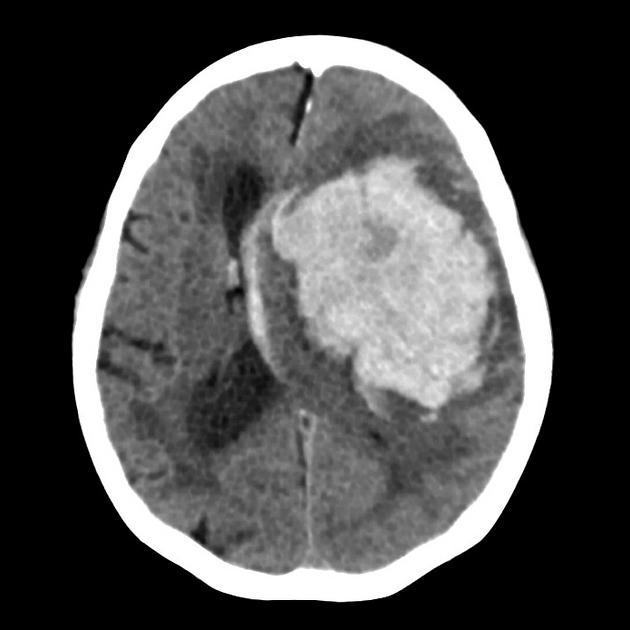
a. CT findings
- Large irregular left hyperdense lesion consistent with intracerebral haemorrhage.
- Surrounding oedema.
- Significant midline shift and mass effect.
- Widespread left-sided sulcal effacement.
- Compression of the left lateral ventricle.
- Contralateral lateral-ventricle dilatation suggesting early hydrocephalus.
- Intraventricular extension.
- Mixed density, swirl sign, or black-hole sign.
b. Likely cause
- Spontaneous hypertensive intracerebral haemorrhage; arteriosclerosis or amyloid angiopathy are also acceptable spontaneous causes.
c. Palliative medications
| Medication | Dose and route | Indication |
|---|---|---|
| Morphine | 2.5-5 mg SC hourly PRN +/- 10 mg/24 h by CSCI | Pain or agitation |
| Fentanyl | 25-50 mcg SC hourly PRN +/- 100 mcg/24 h by CSCI | Pain or agitation if preferred to morphine |
| Midazolam | 2.5 mg SC hourly PRN or 10 mg/24 h by CSCI | Anxiety or agitation |
| Haloperidol | 0.5-1 mg SC every 2-4 h PRN or 1-3 mg/24 h by CSCI | Agitation or nausea |
| Metoclopramide | 10 mg SC TDS PRN or 30 mg/24 h by CSCI | Nausea/vomiting |
| Hyoscine butylbromide | 20 mg SC every 4 h PRN or 60-120 mg/24 h by CSCI | Respiratory secretions |
| Glycopyrrolate | 200-400 mcg SC every 2 h PRN | Respiratory secretions |
d. Other end-of-life measures
- Move to a private, quiet space where possible.
- Address cultural, spiritual, and religious needs.
- Cease routine observations and remove non-beneficial monitoring.
- Provide social work, bereavement, and family support.
- Reposition and optimise comfort, temperature, lighting, blankets, and clothing.
- Maintain clear communication with next of kin.
- Arrange transfer to an appropriate palliative ward if death is not imminent in ED.
Comments are closed for this SAQ.