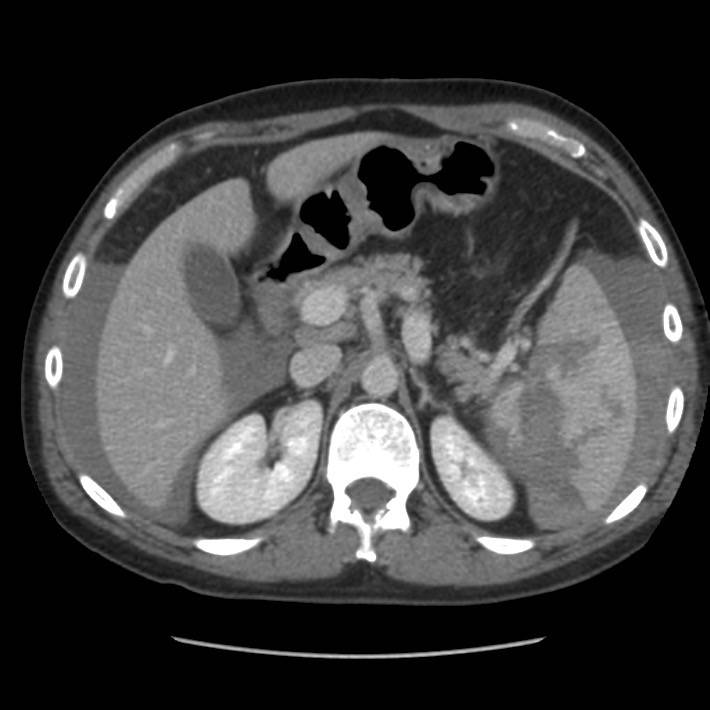
SAQ 456 – Trauma – high-grade splenic injury and massive transfusion
Model Answer
Trauma – high-grade splenic injury and massive transfusion.
a. Diagnosis and CT features
- High-grade splenic laceration/injury with haemoperitoneum.
- Splenic parenchymal laceration or fracture.
- Intraparenchymal or subcapsular haematoma.
- Free intraperitoneal fluid consistent with blood.
- Possible contrast blush or vascular injury if seen on the source image.
b. Conservative versus operative management
| Approach | Advantages | Disadvantages |
|---|---|---|
| Conservative | Avoids laparotomy and preserves splenic immune function. | Requires haemodynamic stability and close monitoring in a centre with surgical and interventional radiology support. |
| Conservative | Avoids operative morbidity and anaesthetic risk. | Risk of delayed bleeding or rupture. |
| Conservative | Angioembolisation may control selected vascular bleeding without splenectomy. | May fail and require urgent operation after deterioration. |
| Operative | Definitive haemorrhage control in unstable patients or peritonitis. | Laparotomy and anaesthetic morbidity. |
| Operative | Allows treatment of associated intra-abdominal injuries. | Splenectomy carries lifelong infection risk and vaccination/antibiotic implications. |
| Operative | Avoids prolonged uncertainty when bleeding continues despite transfusion. | Higher pain, recovery time and complication burden than successful non-operative management. |
c. Massive transfusion
- Use a balanced massive transfusion ratio, for example packed red cells:FFP:platelets 1:1:1.
- An alternative protocol such as 4 units red cells:4 units FFP:1 adult platelet pool is acceptable if aligned with local policy.
- Add cryoprecipitate guided by fibrinogen, give calcium replacement as needed, and consider tranexamic acid early in traumatic bleeding.
- Supporting evidence includes PROPPR, PROMMTT or CRASH-2.
Comments are closed for this SAQ.