You work in a Level 1 Trauma Centre and receive pre-notification of a 23-year-old man in a high-speed single-vehicle crash into a pole.
He has abdominal injuries, was intubated at the scene, has one large-bore IV cannula, has received 250 mL normal saline, and has been placed in a hard collar and pelvic binder.
After initial expert management his haemodynamics improve enough for CT. Two consecutive abdominal CT slices are shown.
| Observation |
Value |
| Temperature |
34 degrees C |
| HR |
160 bpm |
| BP |
75/50 mmHg |
| SpO2 |
99% on FiO2 0.6 |
| GCS |
3 (E1 M1 V1) |
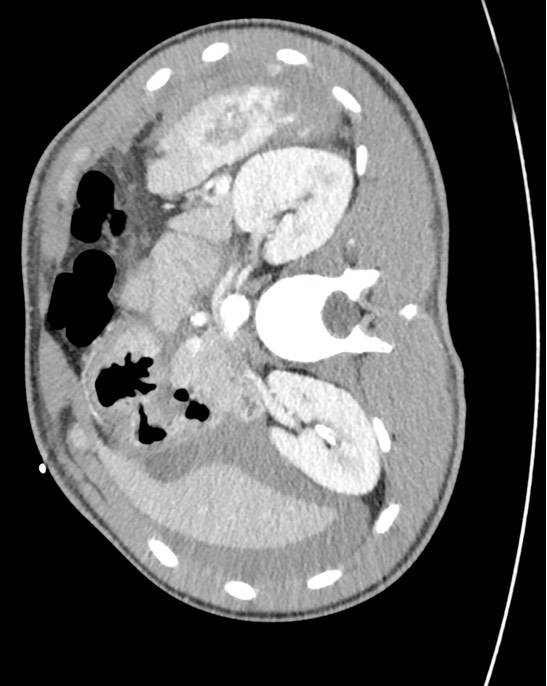 Abdominal CT slice 1
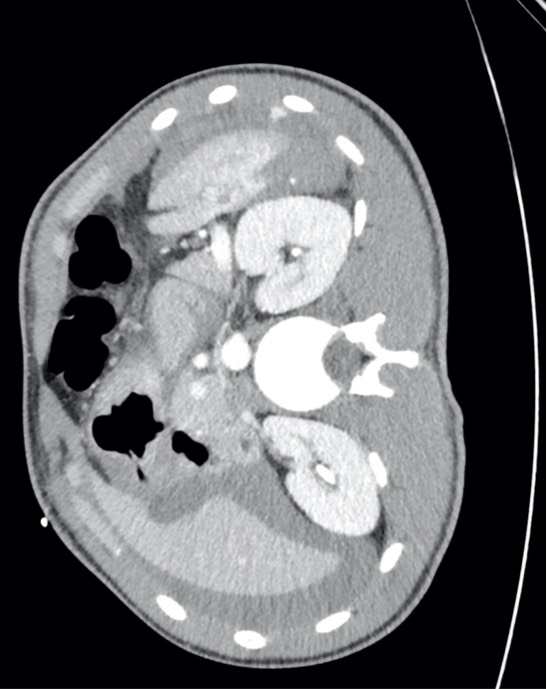 Abdominal CT slice 2
List the three (3) components of the lethal triad of trauma. For each component, list two (2) actions you would take to reduce morbidity and mortality.
(Marked out of 9.0)
/ 9
State the three (3) most important findings on the abdominal CT.
(Marked out of 3.0)
/ 3
List three (3) indications for angioembolisation in this context.
(Marked out of 3.0)
/ 3
List four (4) laboratory targets you would use to guide massive transfusion.
(Marked out of 4.0)
/ 4
Total Score: 0 / 19
Percentage: 0%
Comments are closed for this SAQ.