A 41-year-old woman presents after syncope with a minor cheek laceration. She lives alone, cannot recall the event and says she found herself on the floor covered in blood.
She denies medical problems, has vomited intermittently for three days, takes no regular medicines, smokes one packet daily and drinks four bottles of wine a week. She denies alcohol in the preceding 48 hours.
Vital signs, cardiorespiratory examination and abdominal examination are normal. The ECG is shown.
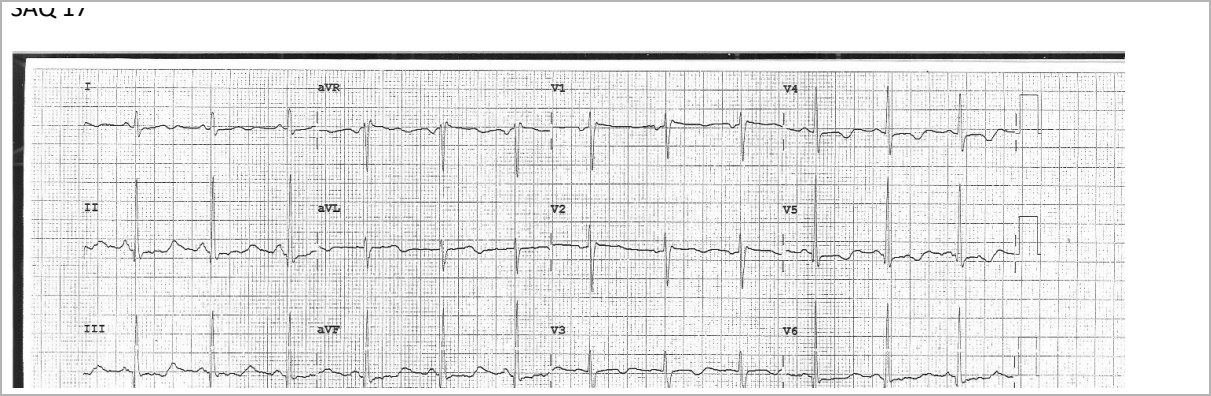 12-lead ECG.
Describe and interpret the ECG.
(Marked out of 3.0)
/ 3
The blood tests are shown. List your three main concerns and write short notes on your approach to each.
(Marked out of 9.0)
| Test |
Result |
| Sodium |
130 mmol/L |
| Potassium |
2.5 mmol/L |
| Chloride |
93 mmol/L |
| Bicarbonate |
18 mmol/L |
| Urea |
5.6 mmol/L |
| Creatinine |
59 micromol/L |
| Anion gap |
22 mmol/L |
| Bilirubin |
19 micromol/L |
| Albumin |
44 g/L |
| ALP |
65 U/L |
| GGT |
643 U/L |
| ALT |
107 U/L |
| AST |
256 U/L |
| Magnesium |
0.73 mmol/L |
| Beta-hCG |
<1.2 IU |
| WCC |
12.1 x 10^9/L |
| Haemoglobin |
127 g/L |
| Platelets |
105 x 10^9/L |
/ 9
List four non-ischaemic causes of T-wave inversion or ST depression.
(Marked out of 4.0)
/ 4
Total Score: 0 / 16
Percentage: 0%
Comments are closed for this SAQ.