A 25-year-old man is brought to your tertiary ED after a major motor vehicle crash. He was the driver of a van that collided head-on with a sedan on a highway.
He was retrieved by helicopter from a rural hospital, where he was intubated for reduced consciousness and a right intercostal catheter was inserted. His initial chest X-ray is shown below.
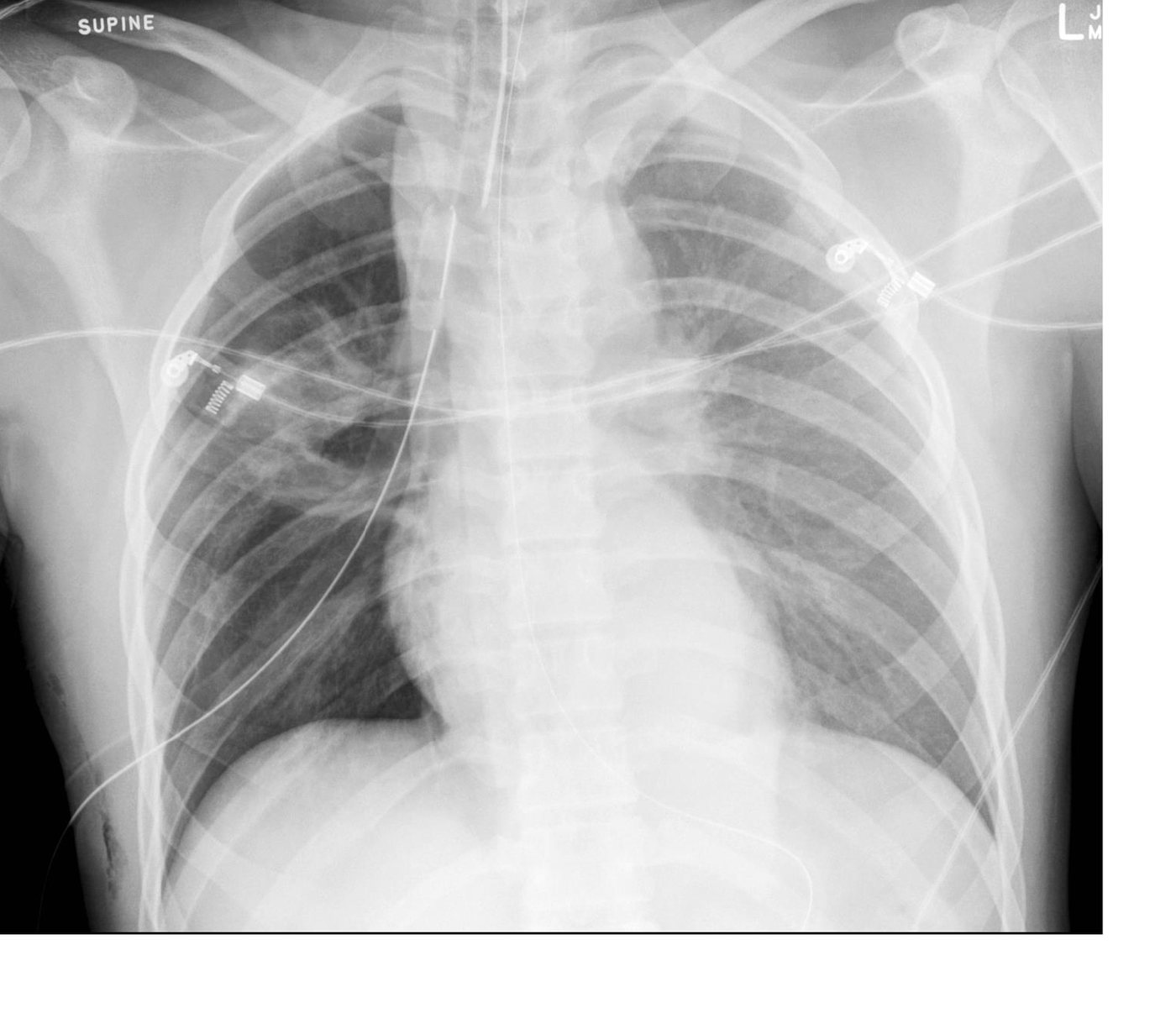 Initial chest X-ray.
His initial observations are pulse 130/min, BP 75/45 mmHg and oxygen saturation 86%. An arterial blood gas taken during initial management is shown below.
| Parameter |
Result |
Reference range |
| FiO2 |
0.4 |
|
| pH |
6.86 |
7.35-7.45 |
| pCO2 |
75 mmHg |
35-45 mmHg |
| pO2 |
55 mmHg |
|
| HCO3 |
13 mmol/L |
22-33 mmol/L |
| Na |
138 mmol/L |
135-145 mmol/L |
| K |
6.1 mmol/L |
3.5-5.2 mmol/L |
| Cl |
101 mmol/L |
95-110 mmol/L |
| Lactate |
11.5 mmol/L |
0.5-2.2 mmol/L |
List four pathologies shown on the chest X-ray. For each, give one supportive radiographic feature.
(Marked out of 8.0)
/ 8
List four abnormalities on the arterial blood gas and give the most likely explanation for each.
(Marked out of 8.0)
/ 8
State four initial actions you would take based on all of the clinical information provided.
(Marked out of 4.0)
/ 4
List four measures you would use to minimise the chance of this patient developing a coagulopathy.
(Marked out of 4.0)
/ 4
Total Score: 0 / 24
Percentage: 0%
Comments are closed for this SAQ.