A 72-year-old man arrives by ambulance with shortness of breath. He is sweaty and appears unwell but remains conscious. He has ischaemic heart disease and an AICD in situ.
Vital signs are pulse 150 bpm, BP 75/- mmHg, RR 30/min and SaO2 96% on 15 L via non-rebreather mask. The initial 12-lead ECG and post-cardioversion rhythm strip are shown below.
You decide to perform DC cardioversion. After IV access is placed, the venous blood gas below is available.
| Test |
Result |
Reference range |
| pH |
7.35 |
7.35-7.45 |
| pCO2 |
57 mmHg |
32-45 |
| Lactate |
3.3 mmol/L |
0.5-1.6 |
| Potassium |
6.1 mmol/L |
3.5-5.2 |
| Creatinine |
160 micromol/L |
60-110 |
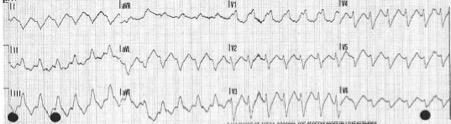 Initial 12-lead ECG.
 Post-cardioversion rhythm strip.
What rhythm is shown on the initial ECG?
(Marked out of 1.0)
/ 1
What other treatment is required while cardioversion is being arranged?
(Marked out of 2.0)
/ 2
Outline two (2) pharmacologic agents you could use for sedation, with initial doses and one advantage and one disadvantage for each.
(Marked out of 8.0)
/ 8
Describe the defibrillator settings and pad positioning you would use.
(Marked out of 2.0)
/ 2
After cardioversion with sedation, describe the rhythm shown on the rhythm strip.
(Marked out of 1.0)
/ 1
Despite the ECG change he remains hypotensive, pulse 100 bpm and SBP 80 mmHg. Give two (2) differential diagnoses.
(Marked out of 2.0)
/ 2
Total Score: 0 / 16
Percentage: 0%
Comments are closed for this SAQ.