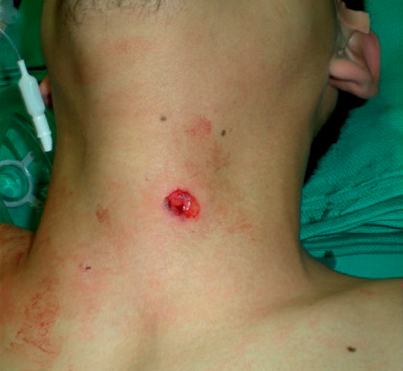
SAQ 399 – Trauma – penetrating neck injury and threatened airway
Model Answer
Trauma – penetrating neck injury and threatened airway.
a. Neck zones
| Zone | Landmarks |
|---|---|
| Zone 1 | Clavicle to cricoid cartilage. |
| Zone 2 | Cricoid cartilage to angle of mandible. |
| Zone 3 | Angle of mandible to base of skull. |
b. Structures at risk
| Zone | Structures |
|---|---|
| Zone 1 | Proximal common carotid artery, subclavian artery, vertebral artery, lung apices, trachea, thyroid, oesophagus, thoracic duct, spinal cord, superior mediastinum. |
| Zone 2 | Carotid artery, vertebral artery, jugular vein, pharynx, trachea, oesophagus, larynx, vagus nerve, recurrent laryngeal nerve, spinal cord. |
| Zone 3 | Vertebral artery, distal carotid artery, distal jugular vein, salivary/parotid glands, cranial nerves IX-XII. |
c. Hard signs
- Airway compromise or obstruction.
- Expanding haematoma.
- Severe active bleeding.
- Shock not responding to fluids.
- Haematemesis.
- Neurological deficit.
- Massive subcutaneous emphysema.
- Air leak through the wound.
- Vascular bruit or thrill.
d. Management steps
- Sit the patient upright, give oxygen as tolerated, and allow the position of comfort.
- Recognise the need for emergent airway control, ideally in a controlled environment such as theatre, and call anaesthetics and ENT urgently.
- Plan gaseous induction or fibreoptic intubation with surgical backup.
- Give analgesia and antiemetics.
- Prepare for RSI if deterioration occurs and assess feasibility of front-of-neck surgical airway.
- Avoid bag-mask ventilation because it may distort neck anatomy.
- Consider nebulised adrenaline with or without IV steroids.
- Consider IV glycopyrrolate to reduce secretions.
Comments are closed for this SAQ.